Writing
[Java Ring] 08. The Java Ring Has Come Back to Life!
In the recent television broadcast, the Java Ring successfully came back to life. Here is a look back at the broadcast and what happened around it.
In the previous article, I reported that the effort to revive the Java Ring would be featured on Knight Scoop, a television programme by Asahi Broadcasting Corporation.
This time, I shall look back at the technical matters that were happening behind that broadcast, as well as the reactions after it aired. (Some details may be intentionally omitted or blurred. My site is less an educational resource and rather more a form of entertainment, so I hope you will forgive me.)
Introduction#
Well then. In the recent broadcast on 10 July 2026, the Java Ring successfully came back to life, and it was able to brew coffee to my liking. Did you all watch it?
I submitted this request at the end of last year, so there was more than half a year of preparation before the broadcast (though, to be honest, I did almost nothing for most of it). Let us look back at what happened before it actually aired, and at the reactions that reached me afterwards.
Acknowledgements#
So many people helped make the revival of the Java Ring possible.
Alongside Matsuoji, who actually opened the Java Ring, there were Yuichi Sakuraba, Naoki Rodion Ishihara, Hiroki Ooyama, Tomohiko Suetsugu, and Akiko Iwakiri, who appeared on the programme with me. I also owe a great deal to Satoshi Kimura, who watched from the observation seats, and to Kazuyuki Shudo, who joined the recording remotely.
Behind the scenes, Miko Matsumura, Tim Lindholm, members of the former Java Ring development team, and former employees of Dallas Semiconductor also provided technical information, period materials, and invaluable advice.
Including those whose names I cannot list here, the knowledge, memories, documents, and enthusiasm of many people supported the effort, and made it possible to bring the long-dormant Java Ring back to life.
And while chasing after the Java Ring, I somehow found myself connected, one after another, with people who had developed it or had been involved with it at the time. Honestly, I was just as surprised by the spread of these connections as I was by the Ring actually working.
To everyone who helped, thank you very much indeed. I hope we shall stay in touch from here on as well!
The Recklessness and Possibility of Revival: Success#
Now, let us return to the technical story (this blog is, after all, entertainment).
It is easy to say, "Let us revive the Java Ring" or "Let us replace the battery", but actually doing it is rather difficult. We had no clear idea of the internal structure of the ring, and inside it was a circuit board that absolutely must not be damaged. For that matter, it was not even certain whether the ring and the iButton could be separated at all. There was also the uneasy feeling of whether I, of all people, had any right to open such a precious object (that is, possibly break it).
This is true of making and repairing things in general: in order to fix something, one needs systematic knowledge about it. If information is not linked together into knowledge, then when trouble occurs one can do nothing, and in the first place it would be discourteous to the Java Ring.
So I decided to use the Internet to gather every piece of information I could find, read it carefully, and build that knowledge.
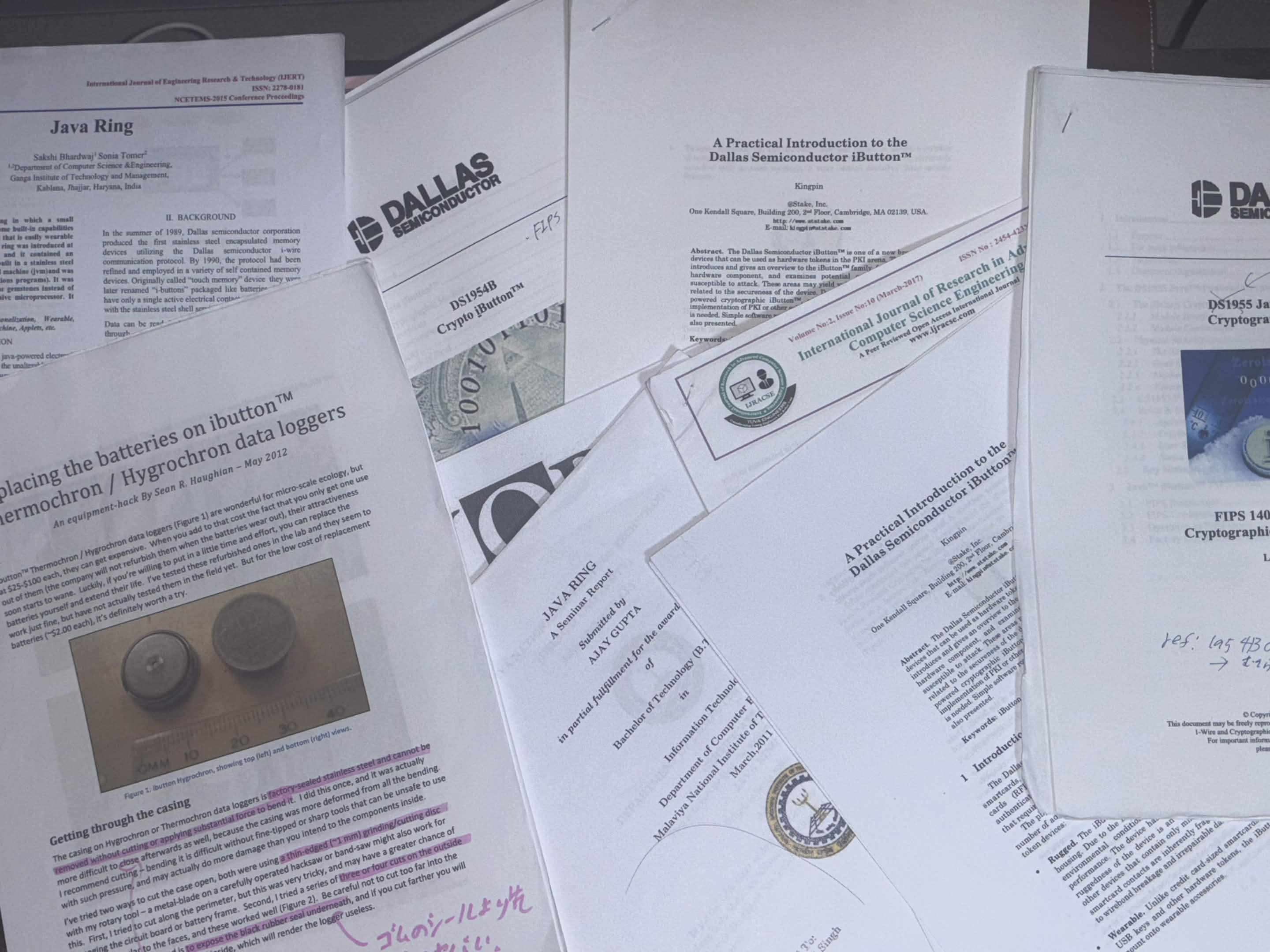
As I continued investigating, the internal structure of the Java Ring gradually came into view.
What Earlier People Had Done#
The first major breakthrough was finding a report by Sean Haughian on replacing the batteries in iButtons. It explained the internal structure and the battery replacement procedure with photographs and cautions, and gave me hope that the battery in the Java Ring might be replaceable as well. It also said that a 1225-series coin cell was used, which was extremely helpful information (I promptly ordered BR1225 cells!).
On the other hand, Sean's method involved cutting four places on the side of the iButton with a grinder, and that did not look as though it could be put back together afterwards. There was even a note saying that if you had ground away more than 2 mm in that area, you would be better off buying a new iButton... which was rather troubling. It seemed wiser to think of an entirely different approach.
Where the JVM Lives#
The biggest point of contention was this: is the JVM stored in EEPROM, or is it stored in NVRAM? If it lives in NVRAM, then the moment the capsule is opened and power is cut, it would probably vanish.
In one of the documents I found, JAVA RING (probably a bachelor's report), it said that the Java Ring had 32 KB of ROM, and that the JVM was stored there. Meanwhile, Kingpin, A Practical Introduction to the Dallas Semiconductor iButton(TM) says things like "6 kB of non-volatile RAM and 64 kB of ROM provide enough memory space for the pre-loaded JVM".
The two sources are not fatally contradictory, but they do differ slightly. It was certain that RAM and ROM existed, but this did not tell us where the JVM actually lived, or whether it was split between both (which is entirely plausible, given the capacity). I suspected it was probably in ROM, but I had no certainty.
That was the state in which I went into the recording. On the day of the shoot, nobody from Dallas or the Java Ring team was present, but there were adults there who had been granted their knowledge. And those adults all said, in chorus, "Isn't the JVM in RAM?"
I have rarely been so flustered (I think I may have been calmer even when I realised, after an examination had started, that I had forgotten my pencil case). Certainly, considering the period, it was perfectly plausible. If a small bootloader in ROM launched the JVM in NVRAM, the same chip could be reused across product variations. It would also be a rather reasonable choice if customisation were meant to be easy.
While thinking vaguely along those lines, and still unable to abandon the possibility that the JVM was in ROM, the ring was finally opened successfully. The battery replacement also succeeded, and when we tried connecting it, it responded!
I thought we had it, but only for a moment. A CRC error (Invalid Signature) occurred, and we could not write a programme to it. Perhaps the MasterPIN required for writing had also vanished (we later learned that it was not needed after all). Everyone then tried all the plausible MasterPIN candidates we could think of, but the result was the same. Perhaps the JVM really was in ROM after all.
After the studio recording ended and I returned home, I immediately began trying all sorts of things. After about three days of trial and error, I finally succeeded in writing a programme, and even succeeded in executing it after power had been cut. The JVM had, in fact, been in NVRAM!
After the Broadcast#
Once the programme aired, the Java Ring and Java were discussed on Twitter, Facebook, and in various media outlets. As someone who loves Java, this made me very happy.
It Became News#
To my surprise, the story was distributed simultaneously to Oricon News and several other news sites that share content. The content is the same, but seeing it spread to so many places is still a delight.
- Yahoo! ニュース: <探偵!ナイトスクープ>指輪型コンピューター「Javaリング」 動かしたいが年代もの 「壊れない」のがコンセプト、再起動に四苦八苦 (Archive)
- MANTAN WEB: 探偵!ナイトスクープ:指輪型コンピューター「Javaリング」 動かしたいが年代もの 「壊れない」のがコンセプト、再起動に四苦八苦 (Archive)
- Oricon: 『探偵!ナイトスクープ』30年前の指輪型コンピューターを復活させたい→“Javaの神様”が助っ人に (Archive)
- 産経ニュース: 『探偵!ナイトスクープ』30年前の指輪型コンピューターを復活させたい→“Javaの神様”が助っ人に (Archive)
- Livedoor ニュース: 『探偵!ナイトスクープ』“Javaの神様”&プロモデラーも参戦!指輪型コンピューターのデータ消滅の危機を乗り越える分解大作戦! (Archive)
- docomo ニュース: 『探偵!ナイトスクープ』30年前の指輪型コンピューターを復活させたい→“Javaの神様”が助っ人に (Archive)
- MSN ニュース: 『探偵!ナイトスクープ』“Javaの神様”&プロモデラーも参戦!指輪型コンピューターのデータ消滅の危機を乗り越える分解大作戦! (Archive)
Further articles were also written after the broadcast:
- Livedoor news: 90年代の指輪型コンピューター『Javaリング』復活に挑む!“Javaの神様”ら集結、強固すぎるセキュリティの結末と“衝撃のオチ” (Archive)
- Abema times: 90年代の指輪型コンピューター『Javaリング』復活に挑む!“Javaの神様”ら集結、強固すぎるセキュリティの結末と“衝撃のオチ” (Archive)
I Also Read This Blog Post#
Akiko Iwakiri, who took part in the recording, wrote an article about the Java Ring and JavaOne in 1998, and about the story behind the birth of Developers Summit.

It tells a fascinating origin story from an era when JavaOne and VBITS were held side by side in San Francisco, and Java and Microsoft seemed to be clashing across the whole city. It is a very interesting piece, giving a sense of the atmosphere at JavaOne back then and explaining why Developers Summit took the shape it did. Please do read it as well.
Finally#
I am very happy that the Java Ring, which had been asleep for nearly thirty years, can now run programmes once again.
In The Java Story, released today, one aspect of Java is described as "Write once, Run forever".
The revival of this Java Ring may well have been an event that embodied those words exactly. A tiny computer made thirty years ago began moving again through nearly lost documents and software, and through the memories of people who knew that time. There was something strangely moving about seeing a programme written in Java run across the years.
The Java Ring has come back to life, but this is not the end. I hope to keep touching Java technology, enjoying both the old and the new, and trying all sorts of things.
Conclusion#
What did you think?
In this article, I looked back at how the Java Ring came back to life on Knight Scoop, as well as the technical story behind it and the reactions I received after the broadcast. To be honest, I had not expected so many people to watch it, write articles about it, and share their memories of Java and the Java Ring from those days.
Next time, I think I shall write about the slightly cool-looking display screen that I hastily prepared for the broadcast. If I have the room, I may also touch on some of the technical details of the Java Ring itself.
Until then.
Addendum (23 July 2026)#
It seems that Asahi Broadcasting Corporation has put the programme video on YouTube. Please do watch it!
Hackaday has also published an article about the Java Ring revival. I am very grateful. Thank you!
Previous: [Java Ring] 07. Let Us Meet at Knight Scoop!
Next: None